
Secrets of the Sahara 2.0

Continuing from the previous post on what can be found when looking closer at the vast areas of the Sahara desert. According to our research, we will find that in Chad, in the dry areas like the Ennedi Massif, all of this major event like happening and withdrawal of water - becomes very apparent. As it does in neighbouring countries like South Sudan, Ethiopia, modern Egypt and Eritrea, it is not quite as dramatic as in Chad. At what time period and how long it took for the water to withdraw in this area, is another question that needs much more research. The traces left us however are all we need, because in this area you will find the HIGEST concentration of what is called prehistoric art (namely times we know from the Bible) anywhere in the world. And you may never have heard of any of this. More prehistoric art and busman paintings then in places like South Africa. Note, we have not been anywhere near this location, so all this is second hand accounts. To go here is even not recommended by UK government and has talked about the region as so-called "highly unstable", but no the area of Ennedi Massif itself. Anyways, proceed with caution.

In the heart of Chad, lies Ennedi Massif and the Ennedi Plateau. This area is about the size of Switzerland, which makes it the largest, ON RECORD, cluster and collection of Rock Art in the world. Especially in the area of Niola Doa, there are images of the people themselves and what they looked like. A window lost in time, into the ancient Biblical civilisations on the continent of Africa. Carved into a sandstone cliff in the heart of Chad, faces painted in white and faded red, men riding different animals, large cows apparently dancing as you pass the rocks with your torch. Thousands of painted images unto the rock. The largest collection in the world some say. With a wide array of styles and themes.

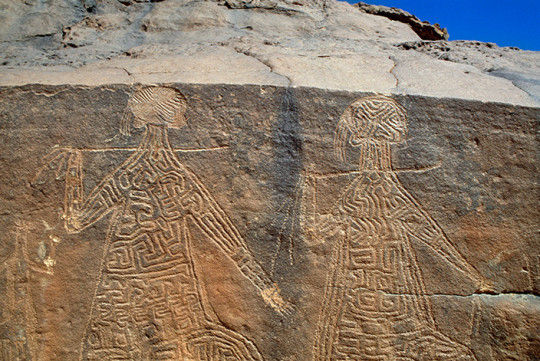
If you investigate these rock etchings closer, you can appreciate their quality, that depicts several groups of human figures following stylistic conventions. Most of these were reported in the 19050s, with more sites reported after that, most of them around Wadi Guirchi, near the site called Niola Doa - which directly translated means the place of the girls. 6 different sites have been documented, with about 40 depictions in total. The located figures were found on big vertical boulders. The same patterns follows. With one main character with a stick across his or her shoulders. Some times with some ornamentation on the neck, some times with skirts and sometimes without clothing.
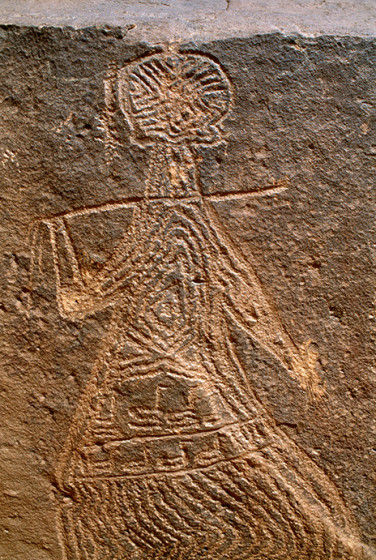
As you can see, these depictions are of African origin. Specifically wide buttocks and thighs. You will find these ancient patterns or inscriptions on the body in other parts of Egypt and Sudan, do also appear in incised pottery. Now the Dinka of South Sudan may be the only tribe left that has remnants of the Body Scarification. Although they do by no means have such intricate and detailed geometrical patterns on their scars. As the People of Ennedi Massif had full blown stories etched into their skin. Intricate geometric patterns, straight lines, wavy lines, squares, rectangles, meanders, living creatures such as birds and many forms of concentric circles. These designs would often correspond to different hairstyles. Now this scarification and different kinds of body decoration and material culture, like potteries, wooden sculptures and various garments is nothing new on the African continent. They are traces of ancient cultures. The problems arise when you try to place a chronology on sites like Niola Doa.

It has though been classified as an older period of Chadian Art. Which we read as being very closely related as Chaldean. Again an older empire from the times of Abraham, and the place he asked called Ur of the Chaldes. People have tried to draw parallels with the Round Head figures of Tassili n`Ajjer in Algeria to the same time period. That would make them something like 9000 years old. They are assumed to be 7000 years old, we se them as both very old and from Biblical time periods. In archeology these periods of time are called so-called Archaic and Pastoral. In and around Ennedi Massif there are similar painted images and could be painted in the same time period although this has not been confirmed, it is however likely. The dancing maidens serves as a site to be explored and researched in the future. To get there you have to drive through the Sahara, some 1000kms. And because of Chads troubles history, there has been years and years of fighting, with military coups, ethnic wars and the wars against Libya. One of the reasons why academics have not really been able to explain what this area is. They could not go there. And about 75% of the surrounding areas remains largely unexplored. One quote has been heard saying these areas are "less explored then the back of the moon". Which makes one wonder. The oldest dated, and you will be shocked to learn how and who sates these dates of oldest Rock Pantings, is the Lascaux in France and Indonesia. We would propose that these are even older.
To give you an accurate understanding of the share size of Ennedi Massif, its almost the size of Switzerland. African Parks now has it under its protection and has been declared an UNESCO World Heritage Site. Which is another sign that this is a place of interest. After they began archeological studies, they have not only started cataloging all these rock art sites, but also the ceramics, plant pollens and the various animal bones. In these studies two names stand out Alessandro Menardi Noguera and Andrea Bonomo. After just 30mins into these newer studies they found a 7000 years old piece of pottery. Bonomo, who has been running trips out to Chad and Ennedi Massif for over 30 years, is quoted saying (Bonomo, Sahara Journal):
"Imagine what they will find with more time."
And we can only imagine, IF only they would be a brave historical archeologist interested in including the full length of the African continent in ancient history. Then we would see some proper results in actually explaining, from a Biblical stand point, what time period these civilisations come from.

In 2001, Bonomo made explanations of a 7,000,000 year (thats a million year old) fossilised skull named Toumaï was found west of Ennedi. Way older the Ethiopias skeleton Lucy. Then they start discussing moving the Origin of Civilisation theory, form Rift Valley and to Chad. A certain Dr. Baba Mallaye says not only has Toumaï been validated through Radio Chronology, which is not very trustworthy according to us, proving its old yes but not the numbers involved. Anyways, in the same area of Toumaï's skull there has been many others. Proving it is not just one single skull. There was a thriving society there. An area of green and glittering lakes, images of elephants, Rhinos, giraffes and ostriches - were all common in Ennedi. The theory is the drying up started more recently, some say 6000 years and the animal would have migrated further south. Animals like Addax and Oryx would have been plenty, and are now almost extinct in the area.

Comments